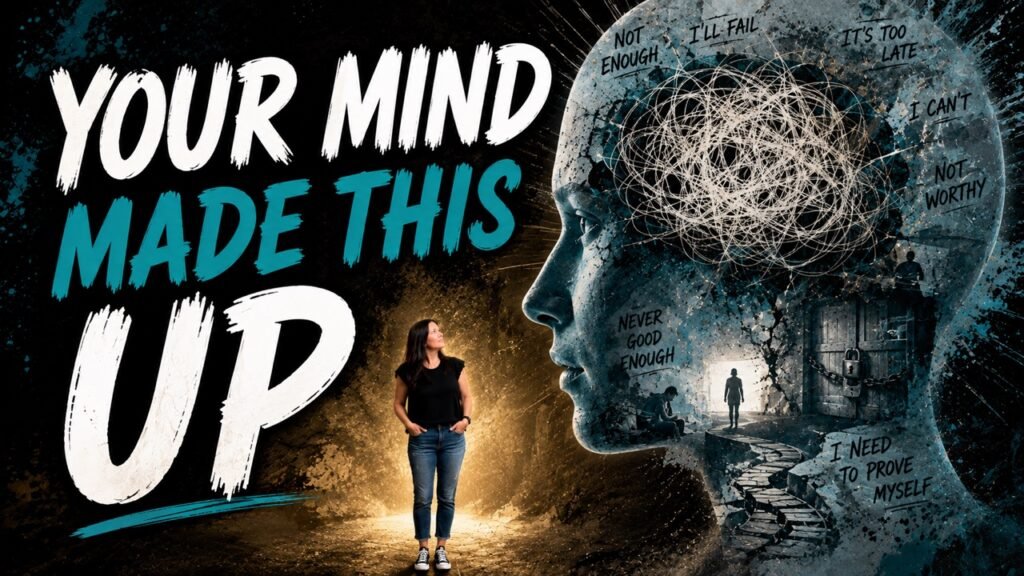
Catching Your Loop: A One-Week Practice
What the Story Alone Doesn’t Show You
You can know exactly what story you’re telling yourself and still miss the part that actually runs your life. The story on its own explains less than it seems to. What actually runs your life is the behavior it produces, and what gets read as confirmation afterward.
The episode has a small, unglamorous example of this. Someone decides they’re bad at small talk, so they stop starting conversations at work events. Nobody approaches them either, because nobody tends to approach the person standing alone by the snacks. The silence gets filed as more proof: “See? I really am bad at this.” Nobody in that story was lying. The story built its own evidence, one quiet exit at a time.
That sequence, story to behavior to confirmation, is easy to explain in a video and much harder to actually catch while it’s running in your own life. A single reflection tells you the story exists. Watching it happen more than once is what shows you the behavior in the middle, which is usually the part you can least see about yourself.
The Weekly Log
Keep this somewhere you’ll actually see it: a notes app, an index card, whatever you’ll open. Each time you catch yourself mid-story, whether it’s happening live or you notice it later, log three things.
What I caught myself saying: ______
What I did (or didn’t do) right after: ______
What happened next that felt like proof: ______
Log it whenever you notice it during the week. Give each entry enough attention to capture what actually happened.
Catching It After the Fact Still Counts
The episode talks about catching a loop “while it’s running.” That’s the ideal, but it’s not where most people start. The first several times, you’ll probably notice the loop an hour later, or the next morning, or when you’re describing your day to someone else and hear yourself say the sentence out loud.
Log it anyway. The behavior already happened and the “evidence” already landed, so you’re reconstructing rather than intervening in real time. The reconstruction still shows you the shape, and the shape is what you’re actually collecting this week.
What to Look For at the End of the Week
Read your entries together. A single entry tells you a story ran once. A few entries together tell you something more useful: whether the same behavior shows up under different stories, which time of day or situation triggers it most, and what the “evidence” column keeps citing on repeat.
That pattern is the actual target. The episode names three stages (story, behavior, evidence), but a few entries together can turn “I have a story about money” into something closer to “I go quiet in money conversations specifically when someone else brings up numbers first, and I read the silence afterward as proof I’m bad with it.” That level of specificity gives you an actual behavior to work with instead of a broad label about yourself.
Change One Part of the Loop
Somewhere this week, try to catch the loop right as the story appears, before the usual behavior follows it. The episode’s own instruction here is the right size: choose one small action that challenges the old story — something the story wouldn’t have predicted, sized so it’s actually doable today.
Story appears. Normally you’d do X. This time, try Y instead. Log what actually happened.
What I did differently, and what happened instead: ______
This is the entry that matters most. As the episode puts it, “a small completed action isn’t a story, it’s data, and your nervous system trusts data in a way it stopped trusting promises a long time ago.” That’s exactly what this entry generates.
Back to the Episode
Rachel didn’t catch her loop live either. It took eight years, and the moment that finally worked wasn’t dramatic: one sentence, written down, read back in her own handwriting. A week of attention like this does deliberately, in days, what usually takes years to happen by accident.
Read the full video transcript
Marie: [00:00:00] Rachel was sitting at her kitchen table when she realized she had been telling the same story about one Tuesday for eight years. The event itself was simple to describe. She had been laid off. The rest of the sentence had grown over time. "I'm replaceable. I'm not valuable. This always happens when I finally feel secure."
One event had become a Narrator.
if an old experience still seems to explain who you are, what other people will do, or how the next chapter will end, stay with me. I'm Marie, and this is Marie Charlie, where awareness and action work together to move a life forward.
We're gonna follow the loop a story creates. The story changes what you expect, expectation changes how you act, and your actions [00:01:00] help produce the evidence the story was waiting for. By the end, you'll be able to catch one of those loops while it's running
Before we do anything else, finish this sentence in your mind: The story I keep telling about this is… Let the answer be ordinary. The most powerful stories usually sound like common sense
the interesting thing about stories is that most of them don't start as stories. They start as experiences. Something happens, maybe when you were young, maybe last year, maybe last week, and then your mind tries to make sense of it. That's completely normal. We're meaning-making machines.
We want explanations. We want certainty. So we take an experience and build a story around it. A relationship ends and the story becomes, "Relationships never work out for me." A business idea doesn't take [00:02:00] off and the story becomes, "I'm not the kind of person who can succeed." You speak up once and someone criticizes you, and the story becomes, "It's safer to stay quiet.
At first, that story may have been your mind's attempt to protect you, a way of creating safety, explaining pain, avoiding future hurt. So I don't wanna make the story wrong. Many of our stories were created by a younger version of us who was simply trying to survive and feel safe. But the challenge is this, sometimes we stop updating the story.
We keep carrying an old explanation long after it stops serving us until we forget it was ever an explanation at all. It starts feeling like reality
one reason this happens is that stories become familiar even when they're limiting [00:03:00] us, and familiar feels safe. If I keep telling myself I'm not good at that, I don't have to risk trying.
If I keep telling myself I'm too old, I don't have to risk starting over. So storytelling may be limiting us, but it may also be protecting us from uncertainty, at least that's what it feels like, because a new story requires us to become available for a new outcome, and that can feel vulnerable.
Here's a way to test which one you're holding. An event is something you could describe the exact same way five years from now, no matter how you're feeling that day. The relationship ended in March doesn't change your mood. A story shifts depending on how you're feeling when you tell it. Some days it's, "That one didn't work out." [00:04:00] Other days it's, "I always pick the wrong people." and the facts underneath haven't moved an inch. If the account changes shape depending on your mood, you're not remembering an event anymore,. You are narrating a story.
You might be thinking, "But what if the story is accurate? What if relationships really don't work out for me?
What if I really am difficult to work with?" Fair question. Here's the honest test. Has this actually been tested as a pattern across genuinely different circumstances, or has it just been repeated across similar ones you kept choosing because the old story told you to expect them? A belief that predicts its own evidence isn't proof. It's a loop being treated as [00:05:00] proof
You might be thinking, what if the story is accurate? What if relationships really don't work out for me? What if I really am difficult to work with? Fair question. Here's the honest test. Has this actually been tested as a pattern across genuinely different circumstances, or has it just been repeated across similar ones you kept choosing because the story told you to expect them?
This matters for a reason beyond just feeling better about the past. Every decision you make today gets filtered through whichever version you're currently telling. If the story says relationships don't work, you'll unconsciously test people the way someone testing a theory does, looking for the confirmation instead of the exception.
The story [00:06:00] doesn't just describe your life. It quietly directs what you notice, who you trust, and what you're willing to risk. That's why examining it matters more simply than feeling sorry about it
and a story rarely stays contained to the one area it started in. The relationship story quietly writes rules for how you show up at work, how much you let a new friend in, whether you volunteer for something that might not go well. One examined sentence can end up drafting policy for rooms it was never actually about
it's worth being honest, too, about why the story felt worth keeping in the first place. Most limiting stories started as a kind of protection, a way to avoid being surprised by the same pain twice. Relationships don't work out for me [00:07:00] guarantees you'll never be blindsided the way you were the first time because you'll have stopped expecting anything else.
That's a real trade, and the story buys you a kind of safety. It just charges more for it than most people realize until they add it up
Marker- add Chapter 2 slide here
—
Marie: Tom started a business in his late 20s. It didn't work out. The timing was wrong, the offer wasn't clear, he needed more support than he had. Reasonable things. But the story he walked away with wasn't that attempt didn't work. It was, "I'm not an entrepreneur." He hasn't started anything since
have you ever watched one painful relationship turn into a permanent verdict? It happens quietly. At first, it's just a painful chapter. It deserves compassion, and it requires healing. But eventually the story can become, [00:08:00] "Relationships never work out for me." Then it becomes, "I can't trust anyone." And then it becomes, "Love isn't safe."
Three sentences, and none of them are facts. All three are conclusions dressed up as self-knowledge, just like we talked about in the last episode
notice how naturally Tom's sentence dressed itself up. He didn't wake up one day and announce, "I've decided I'm not an entrepreneur." It arrived quietly, sounding like humility, like finally being realistic about himself. That's what makes a story so much sturdier than a fact. A fact can be checked and corrected.
A story doesn't feel like something you concluded. It feels like something you're simply being honest about the event happened once. The story gets repeated hundreds or thousands of times, [00:09:00] and after a while, the story becomes a lens. We stop looking at it and start looking through it. When you're looking through something every day, it becomes invisible. You don't notice the lens. You just think you're seeing life clearly
the loop shows up in ordinary places too, not just the dramatic ones. Someone tells themselves, "I'm bad at small talk," so they stop initiating conversations at work events. Nobody approaches them either because nobody tends to approach the person standing alone by the snacks, and the silence gets filed as more proof.
" See? I really am bad at this." Nobody in that story was lying. The story just built its own evidence one quiet exit at a time.
Take a moment and actually go looking for yours. Not the story other people would guess [00:10:00] about you. The one running so quietly you stopped registering it as a sentence at all. It might live in how you talk about money or your body, or whether people actually want you around. However ordinary it sounds out loud, that ordinariness is exactly what's let it run unquestioned for this long
it's rarely a story you built entirely by yourself. Other people help keep it circulating, usually without meaning to. A sibling who says, "You've always been the dramatic one," at every family dinner. A coworker who says, "You know how you get right before you're about to try something new." Nobody in that room is lying.
Most of them think they're just describing you accurately, but every retelling adds another layer of paint to a story you [00:11:00] might have been ready to repaint
and here's the part most people never notice. The story doesn't just sit there quietly. It runs a loop. The story says, "Don't try," so we don't try. Then nothing changes, and then we say, "See? Nothing ever changes." The story says, "Don't trust," so we stay guarded. Then relationships feel distant, and then we say, "See?
People never really show up for me." The story says, "Don't start," so we wait. Then time passes, and then we say, "See? It's too late." This is why awareness matters so much. Without it, we keep trying to change the result while leaving the story that's creating it completely untouched
Catching the loop once doesn't shut it down for good, and it helps to know that going in. A story that's been running for years [00:12:00] doesn't retire after a single honest look. It comes back, usually at the exact moment you're tired or scared, wearing slightly different words. That's not proof the awareness didn't work.
It's just what it looks like to interrupt something that old. The goal was never to delete the loop in one sitting. It's to catch it a little earlier every time it tries to run
psychologist Dan McAdams uses the term narrative identity for the evolving story people create from remembered experiences. We do more than store events. We connect them, we emphasize some, minimize others, and use the resulting story to explain who we are and where our life may be going. That capacity is useful.
A coherent story can help us make meaning. Trouble begins when a story stops evolving while life [00:13:00] keeps moving. McAdam's work does not prove that people who feel stuck are trapped in one early chapter. That would be too neat. It does give us a sound reason to examine the chapter we keep using to interpret everything that follows
Jung Approached the problem through the unconscious: patterns can influence a life before we have language for them. Whatever you think of Jung's larger theories, that observation is familiar. We repeat a response, choose the same kind of situation, or have the same argument in different relationships, and only
later
realize the common thread
This is where the Marie Moment matters. Awareness turns the narrator into something you can hear. Once you can hear it, you can ask whether the story is complete, current, fair to the [00:14:00] life you are living now. The goal is not to replace every painful story with a pleasant one. A useful story can hold the injury and still describe your agency.
It can acknowledge what happened without drafting the ending in advance
stories also change depending on who is listening. Notice whether you tell the same event differently to a trusted friend and a stranger and yourself at 2:00 in the morning. The facts may stay steady while the narrator becomes harsher. That difference is useful information
now, I'm not saying every story is false. Some stories contain real truth, real wisdom, lessons we genuinely needed. So the question isn't, is the story completely wrong? The better question is, is the story complete? Is it current? Is it helping me move forward or is it keeping me stuck?
One useful [00:15:00] check is this. Does the story leave room for a different next chapter, or does it read like it's the final page? "I learned what doesn't work" leaves the book open. "I failed" reads like a last line. Same event, only one version has anywhere left to go. Maybe the story isn't I failed. Maybe it's I learned what doesn't work.
Maybe the story isn't I'm behind. Maybe it's I'm beginning from a deeper place of wisdom. Maybe the story isn't I'm not good enough. Maybe it's I was never taught how to see my own worth clearly. That doesn't erase the past. It reclaims your authority from it. The story is not you. The story is one interpretation of your experiences, and interpretations can change
because some [00:16:00] people here rewrite the story and swing straight into a version that ignores anything difficult ever happened. That's not rewriting, that's avoiding, and it tends to collapse the first time reality contradicts it. A story you can actually keep living inside has to hold what really happened and still leave room for where you're headed, both at once, not one instead of the other
There's a real difference between updating a story and denying one. Updating the story about a layoff might sound like, "That job ending wasn't proof I'm replaceable. It was proof that the market shifted and I need different skills." Denying it would sound more like, "That layoff never really affected me," when it clearly did.
The goal was never to pretend the events didn't happen or didn't hurt. It's to make sure [00:17:00] the meaning attached to them is actually the most accurate one available, not just the first one your mind reached under stress
a quick gut check for whether a rewrite is honest or wishful, read the new version out loud. If part of you flinches because it feels like it's a stretch, it probably needs more evidence behind it before you can actually stand on it. A story doesn't have to feel completely true. Yet to be worth trying on it, it has to just feel possible enough to test
this only works if awareness actually leads somewhere. Awareness by itself isn't the finish line. That's where Charlie comes in. Charlie represents action, movement, courage, the willingness to do something different once awareness has revealed the pattern. Marie reveals the story, and Charlie helps us stop living from it
a story can [00:18:00] contain truth and still be incomplete. Rachel really was laid off. The loss affected her confidence and her finances. A rewrite that skips those facts will feel hollow because part of her knows is being asked to lie. The stronger revision adds what the first telling left out: the market conditions, the choices she made afterwards, the skills she carried into the next role, and the ways one employer's decision could never measure all of her value.
The story becomes larger because the evidence becomes larger
notice how that is different from positive thinking. Positive thinking tries to improve the emotional tone. A fuller story improves the accuracy. Sometimes accuracy feels encouraging. Sometimes it feels sobering. Either way, it gives you better information [00:19:00] for the next decision choose one area of your life where you feel stuck. Just one, not your whole life. Then ask yourself three questions: What story am I telling myself about this situation? Where did that come from? And is that story helping me move forward? Let's make this concrete across a few different rooms of life. In a career, the story might be, "I don't have what it takes to lead."
In a friendship, it might be, " People eventually leave." In your own body, it might be, "I just don't feel like taking care of myself." The setting changes, but the pattern holds. An event that happened once retold enough times to sound like a permanent fact about who you are
write down your answers. Don't rush. Don't judge yourself. Just [00:20:00] become aware. Then look back at what you wrote. Notice which parts still feel true and which ones don't. That's discernment, not judgment. Once you can see that clearly, you get to choose which one shift do you actually wanna make first?
Then choose one small action that challenges the old story. If the story says, "I never follow through," choose one small thing and complete it. If the story says, "My voice doesn't matter," say one honest thing. If the story says, "I'm too old to begin," take one beginner step
before you choose, pause on one more question. Out of every story currently running, which one is actually costing you the most right now? We also kinda completed this in episode one. You probably don't just have one. Most people are carrying three or four all at [00:21:00] once. You don't need to rewrite all of them this week.
You need to just find one that's just holding you back and start there. That's discernment doing its job instead of trying to fix everything in one single sitting
that's what Rachel eventually did eight years later. She didn't quit her job to prove a point or send an inspirational post. She wrote one sentence down. "The event was that I got laid off. The story I built was that I'm not valuable." Reading her own handwriting was the first thing in eight years she'd seen the two as separate things.
She says that was the actual turning point, not the new job, not a big win, just seeing the sentence for what it was. Notice what she didn't do. She didn't wait until she felt confident to write the sentence. [00:22:00] She didn't wait for the story to stop hurting first. She wrote it while it still stung a little bit because the point was never to feel nothing about the layoff. The point was to stop letting the story about the layoff make every decision that came after it
it won't necessarily feel clean the first time. You might question the story and still feel the old pull of it a week later. That doesn't mean nothing happened. The old story needed to run completely unquestioned to keep its grip. The moment you actually separated event from story just once, even if it was brief, it's no longer operating in the dark the same way it used to
there's a reason a small real action works better here than a big declaration. A big declaration is just a new [00:23:00] story, and your nervous system has learned to not fully trust stories anymore. It's been burned by too many resolutions that didn't hold. A small completed action isn't a story, it's data, and your nervous system trusts data in a way it stopped trusting promises a long time ago. It doesn't have to be dramatic. It just has to be real. One small thing that tells your nervous system you're no longer living entirely from the old conclusion
and this doesn't end when the video does. The next time you catch yourself saying, "And that's just how it is," or, "That's just who I am," that's your cue to run the same two questions. Is this an event or a story? And if it's a story, is it complete? You won't always have the time to write it out. Most days, just naming it silently in that moment is enough to loosen its [00:24:00] grip just a little bit.
That's the whole practice, really not a one-time exercise, but a habit of noticing applied over and over to whatever story shows up next. Drop a comment with the one word that fits what you found, event or story. I read these, and it helps me know what to cover next
the story is not you. You may have experienced it, repeated it, believed it for years, built routines and decisions all around it, but that doesn't mean it has to define the rest of your life
you are not the rejection. You're not the label someone placed on you. You are not the old conclusion. You are the awareness that can notice the conclusion, and that matters because the moment you can observe the story, you're no longer completely fused with it. [00:25:00] That makes space, and in that space, a new possibility can enter
none of this requires you to already know how the next chapter goes. It only requires you to notice honestly which sentence has been quietly writing the last several chapters for you, and to write one truer sentence next to it
if you take nothing else from this episode, take this. The version of your life you're living right now was written in part by a story you probably never chose on purpose. That's not a reason for guilt. It's a reason for curiosity. The same mind that wrote the old story without asking your permission is available to write the next one with it.
Awareness opens the door, action walks through it, and transformation happens on the other side
Once we begin questioning the stories we've been [00:26:00] carrying, and that's exactly what we're exploring next, another realization starts to emerge. We are not the stories, we are not the labels, and we are not the past. Once that actually lands for you, something practical changes. You stop asking, "What's wrong with me?"
And start asking, "What's possible for me?" And that one shift in the question changes almost everything that follows it. I'm Marie, this is Marie Charlie, and until next time, take care.